The High-Stakes Exam Protocol
You don't have a time problem. You have a rehearsal problem.
What you call “studying” is dress rehearsal. Rereading, highlighting, re-watching lectures, redoing Q-banks you've seen three times. Your exam doesn't grade the rehearsal. It grades what you can recall, cold, with nothing in front of you. Dunlosky documented the pattern across 254 studies and 14,000 participants. Bjork named it “desirable difficulties.” You've felt it. You just didn't have a name for it either.
There's a shorter, stricter way. Built for people who have twelve hours a week and can't afford to fail.
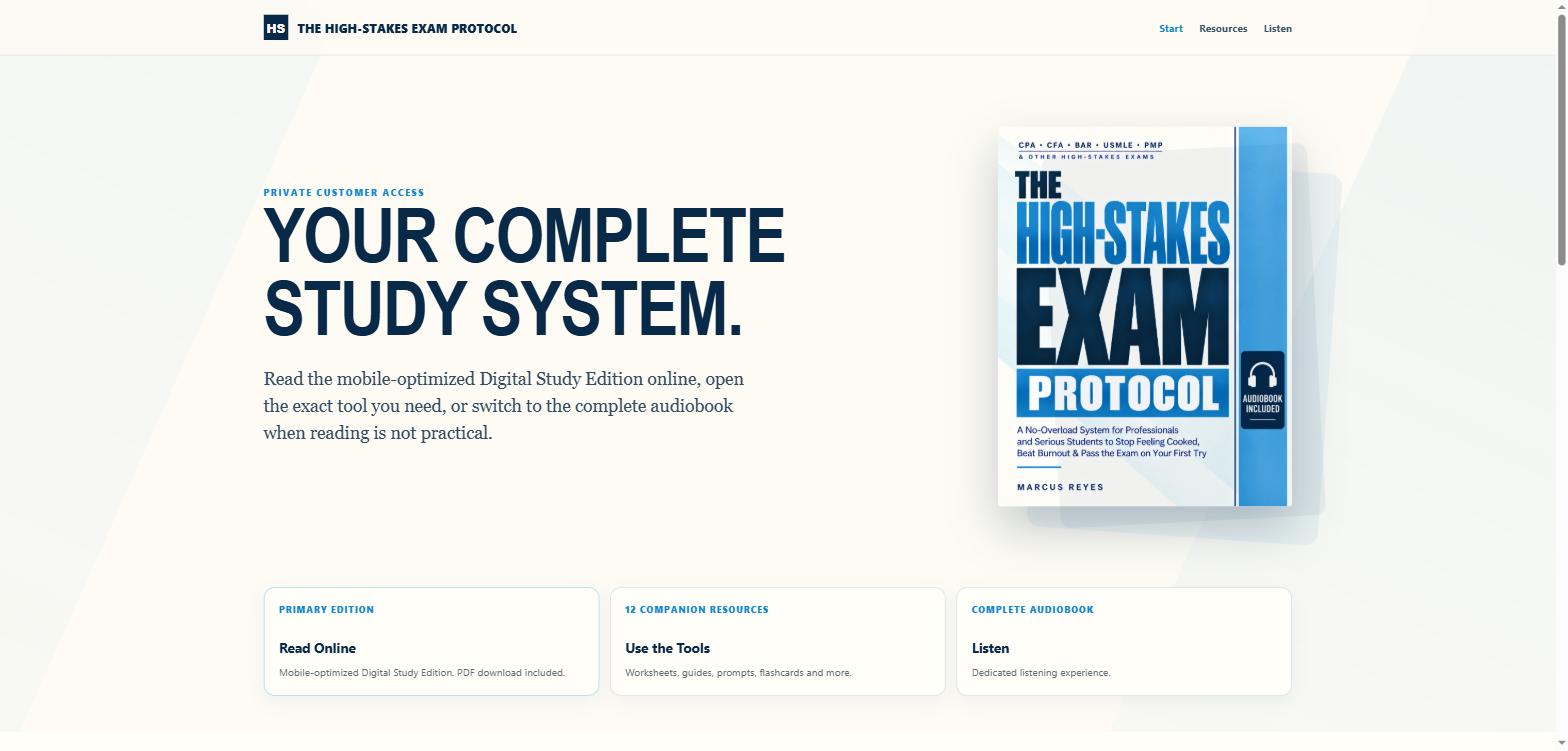
Marcus Reyes
I failed by three points.
I'm Marcus Reyes. I studied every night for three months. I knew the material. I could quote it back to you, recognize it, underline it. But when the questions came at me cold, I couldn't pull it out fast enough.
Three points is nothing. Three points is a lifetime, when it means not this year.
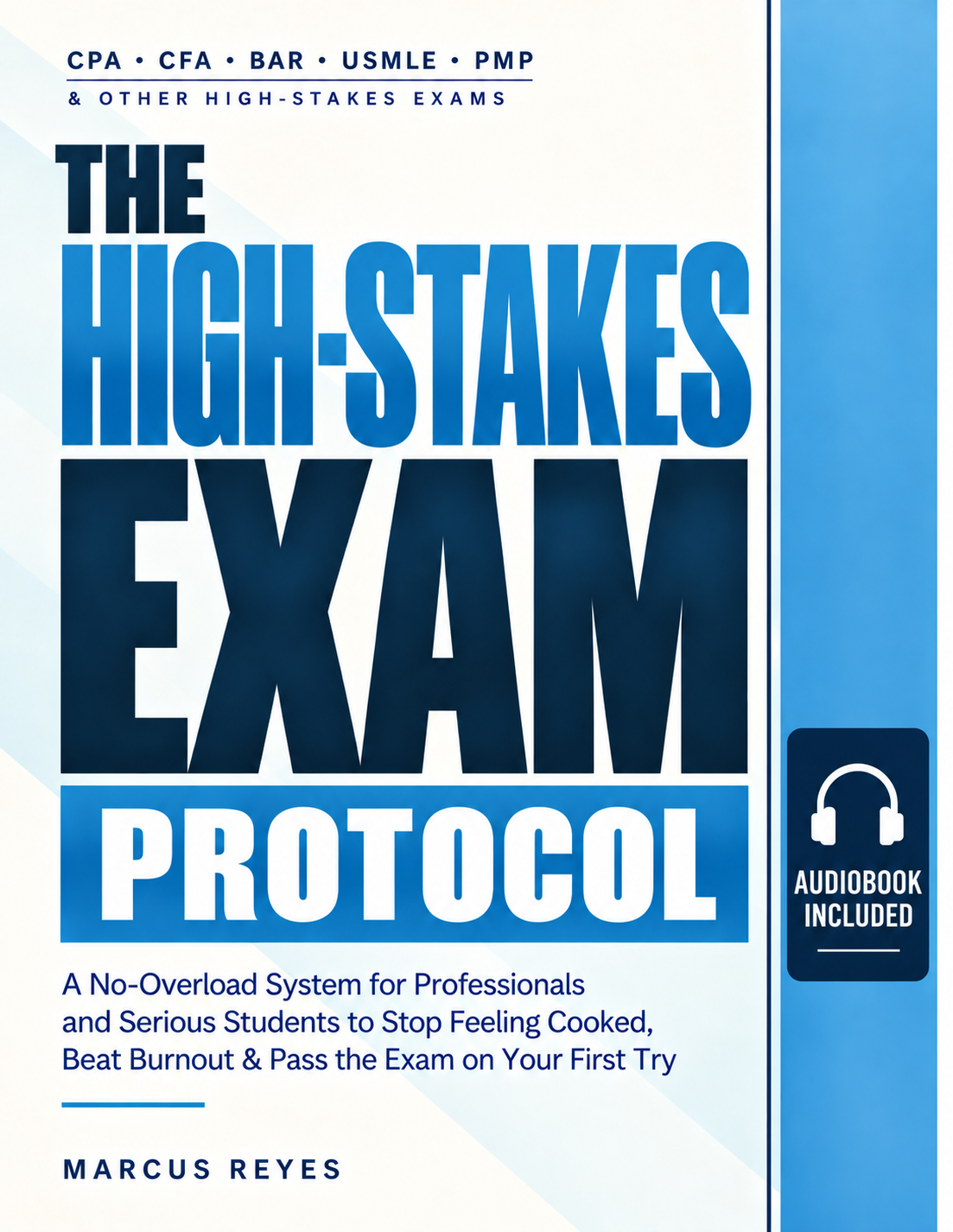
I built The High-Stakes Exam Protocol so you don't do what I did. It's the system I wish I'd had, stripped of every study technique that only feels like studying, and built around the one thing your exam actually tests.
This is a method problem.
If you're preparing for a high-stakes exam while working full-time, raising kids, or holding a life together, you've probably felt this. You review the material and it feels familiar. Then you take a mock exam and blank on questions you'd sworn you knew yesterday. So you do what most of us do. More hours, more rereads, another pass through the Q-bank. And the score doesn't move.
This is a method problem. And the method has a name.
Most of what you're doing right now is not studying. It's reviewing. Rereading textbook chapters. Highlighting First Aid. Re-watching lecture videos. Running the same UWorld or Kaplan Schweser or Barbri set for the fourth time. Reviewing produces the feeling of familiarity. You look at the material and you recognize it. Your brain says: yes, I know this. That feeling is real. That feeling is also a trap.
Your exam asks you to recall material, not recognize it. Recognition and recall live in different parts of your brain, and only one of them shows up on test day.
The pattern is universal. From a candidate posting anonymously on a med student forum:
I feel confident when doing them, but then when I correct them, I am getting most of them wrong… I then get pissed off and just end up closing the book.
From a working professional on a CFA forum:
There's just nothing left in the tank.
If any of that sounds like your last month, this page is for you.
The good news: this is a solvable problem. Not with more hours. With a different kind of hour. An hour that puts you under the same conditions as the exam, and forces your brain to do the one thing the exam measures.
That's what The High-Stakes Exam Protocol is.
The Protocol has four phases.
Not nine chapters. Not a curriculum. Four moves in sequence.
Diagnose.
Before you touch a technique, you spend twenty minutes with a Diagnostic Worksheet that tells you which of four studying patterns you're stuck in. Most of us think we're behind. Most of us are running a broken loop. The diagnosis fixes that first.
Build.
You build a protocol matched to the time you actually have. Fifteen, forty-five, or ninety-minute blocks. Built around the four techniques Dunlosky rated most effective: retrieval practice, distributed practice, interleaving, elaborative interrogation. Every technique in this phase passes one test. Does it produce active recall, or is it theater of productivity? If it fails, it doesn't make it in.
Protect.
You protect the protocol against the two forces that break every study plan built for a life like yours: burnout and interruption. Illness, tax season, a sick parent, a bad week. Most books pretend these don't happen. This one has a chapter on studying while your life falls apart, because that's when most of us are actually doing this.
Sustain.
You build the last mile. The two weeks before the exam, the day before, the walk in. Where most systems taper by adding hours, this one tapers by removing them. On purpose. With reasons.
Four phases. That's the book. Everything else in the Resource Hub exists to serve one of the four.
The mechanism.
Here's the technical spine, because if you're reading this page you already know most of the general research. You want to know what makes this specific.
Three ideas.
One. Retrieval, not review. In 2013, John Dunlosky and four colleagues published a meta-analysis in Psychological Science in the Public Interest. It covered 254 studies and roughly 14,000 participants. Only two of the ten most-taught study strategies got the highest rating for effectiveness: practice testing and distributed practice. Rereading, the single most common study technique in the world, got the lowest.
Two. Desirable difficulties. Robert Bjork's research shows that the techniques that feel worst while you're doing them (spacing, interleaving, testing yourself before you feel ready) produce the strongest long-term retention. Rereading feels productive. Recall feels frustrating. Only one of them builds the memory that survives to test day.
Three. FSRS-6, not rote. If you use Anki, and if you're preparing for USMLE, MCAT, or a major finance or law-school exam you probably do, the Protocol shows you how to configure FSRS-6 with a 90% retention target. The algorithm serves your schedule, not the other way around. If you don't use Anki, there's a tool in the Hub that walks you through it in under fifteen minutes.
Three principles. The rest is execution.
A bar candidate on a private California group put the whole system in four words after she passed:
Don't ‘study.’ PRACTICE.
That's the sentence I couldn't have written myself. She said it while working full-time in a law firm and preparing for the exam in the margins. It's the book, in four words.
What's inside the Hub.
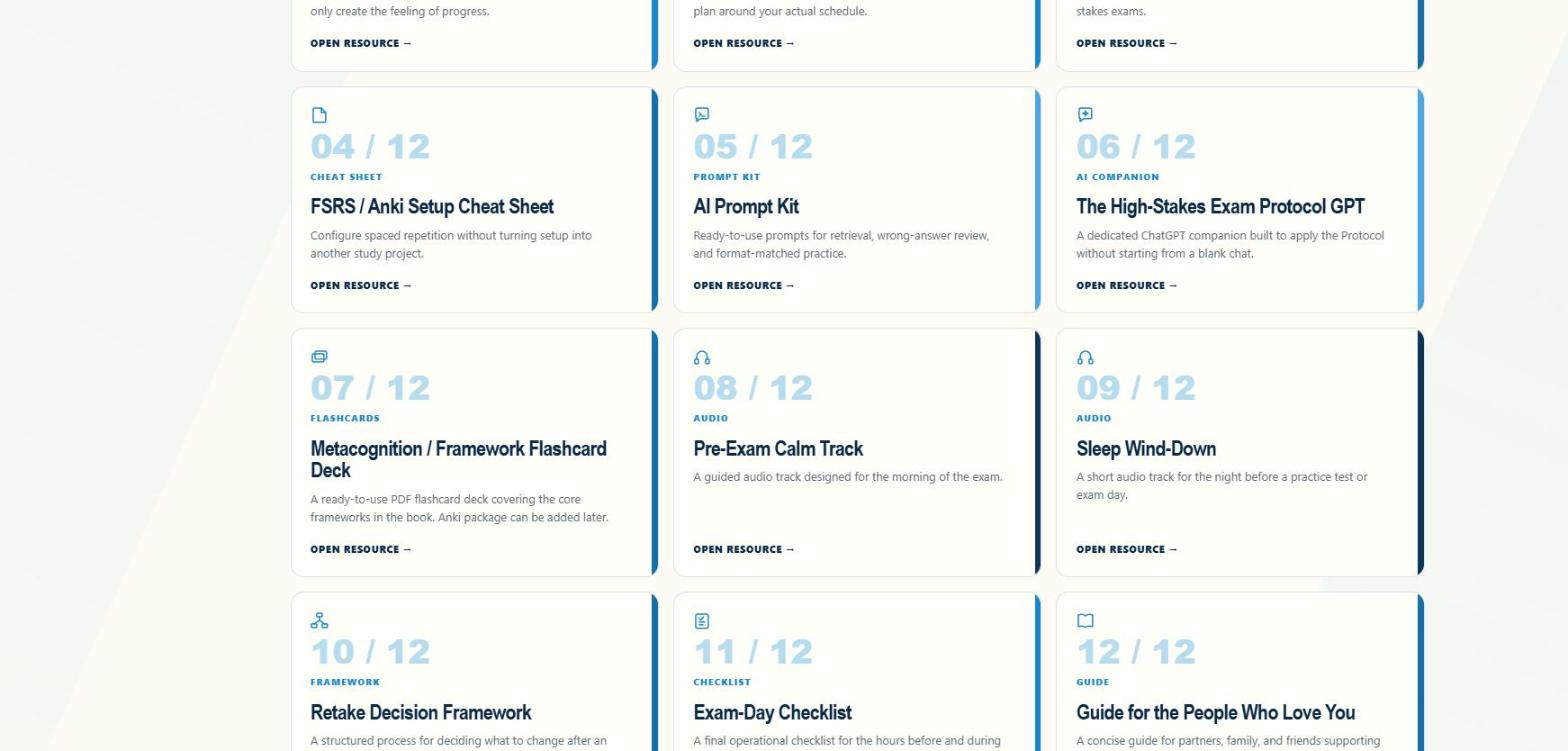
You don't just buy a book. You get a permanent private link to a Resource Hub where the book, the audiobook, over a dozen tools, an AI Study Partner, and printable versions all live at one URL. No codes to type. No login to remember. No app to download. You bookmark one link and everything is there. On your phone at the gym, on your laptop at 11 pm, on the family iPad when your daughter falls asleep on your chest.
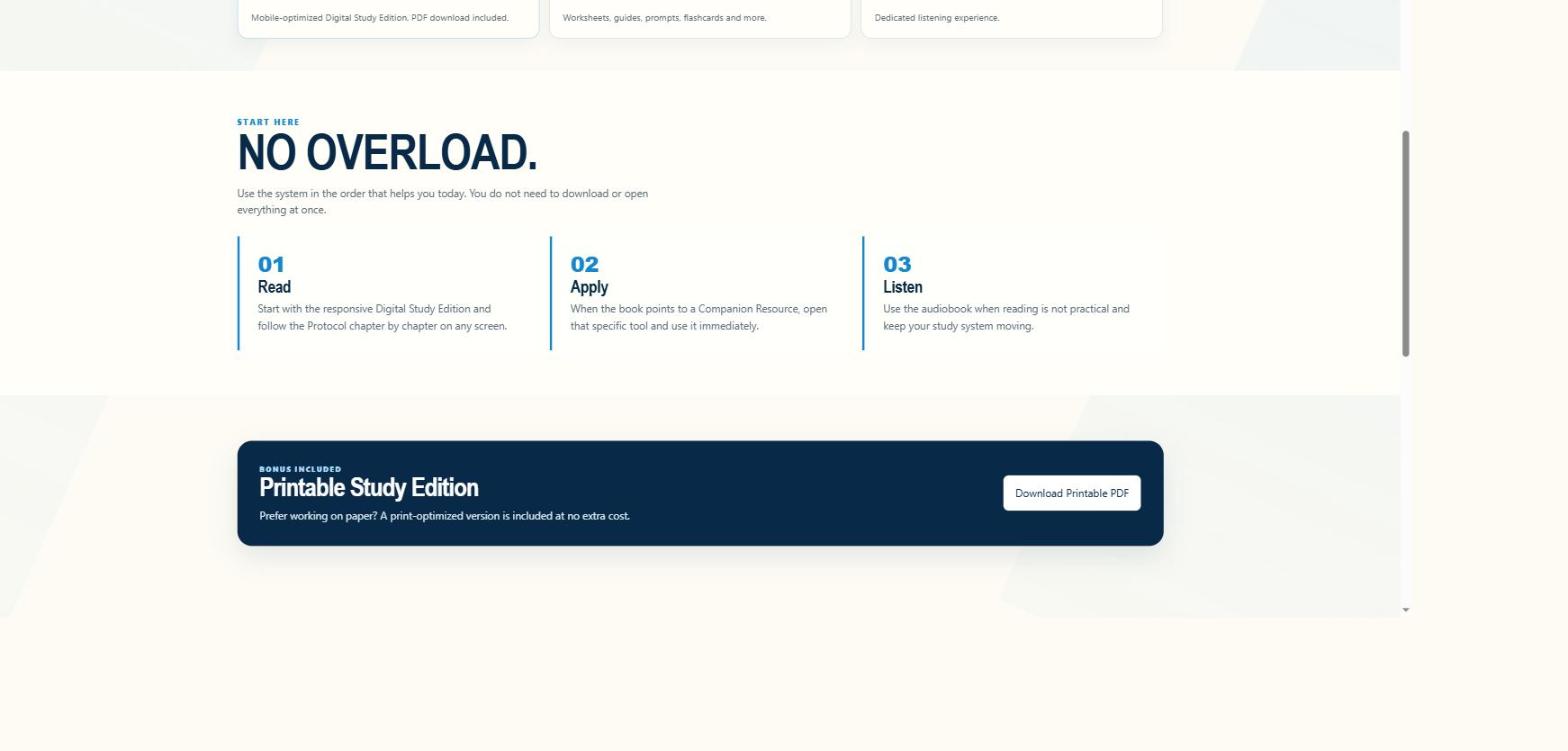
Inside the Hub:
- The book.The High-Stakes Exam Protocol. Every chapter designed to be read in a 45-minute block or less.
- The audiobook.Full narration for the commute, the treadmill, the walk to the coffee shop.
- The 20-Minute Diagnostic Worksheet.The exercise you do before you build anything, to know which broken loop you're running.
- The Weekly Time-Block Planner.A template that maps your 12–15 available hours against the four Protocol phases.
- The FSRS Anki Setup Cheat Sheet.The exact settings, in plain English, for the moment you're overwhelmed by AnKing subreddit threads.
- The Retake Decision Framework.If you've already failed once, this tells you whether to retake in eight weeks, twelve weeks, or change strategy. With criteria, not motivation.
- The Exam-Day Checklist.The last 48 hours, minute by minute. What to eat, when to stop studying, how to walk in.
- The Metacognition Flashcard Deck.Flashcards about how you're studying, not what. They catch you when you drift back into rereading.
- The Guide for the People Who Love You.A short handout for your partner, your parent, your best friend. So they understand what the next twelve weeks look like, and how to help without hovering.
- The AI Prompt Kit.Twelve prompts, ready to paste, that turn ChatGPT or Claude into a Socratic quizzer instead of an answer machine.
- The AI Study Partner.A custom GPT loaded with the Protocol's method. Ask it to build a session plan for tonight. Ask it to grade your explanation of a concept. It won't do the thinking for you. It'll make you do the thinking.
- Exam-specific playbooks.Separate guides for the nine major high-stakes exams: USMLE, MCAT, PMP, CISSP, Bar Exam, CPA, CFA, GRE, LSAT. Every technique in the book, applied to your specific format.
Everything is at one link. That link is yours forever. Every update to the Hub shows up at the same URL. You don't get an email with a new code. You just open the link and it's there.
What you won't find on this page.
No testimonials. No five-star screenshots. No “Sarah C., CPA, Texas, this changed my life.”
This product launched September 21, 2026. It hasn't been on the market long enough to have real customer stories, and I refuse to invent them or pay for them.
Here's what I can show you instead.
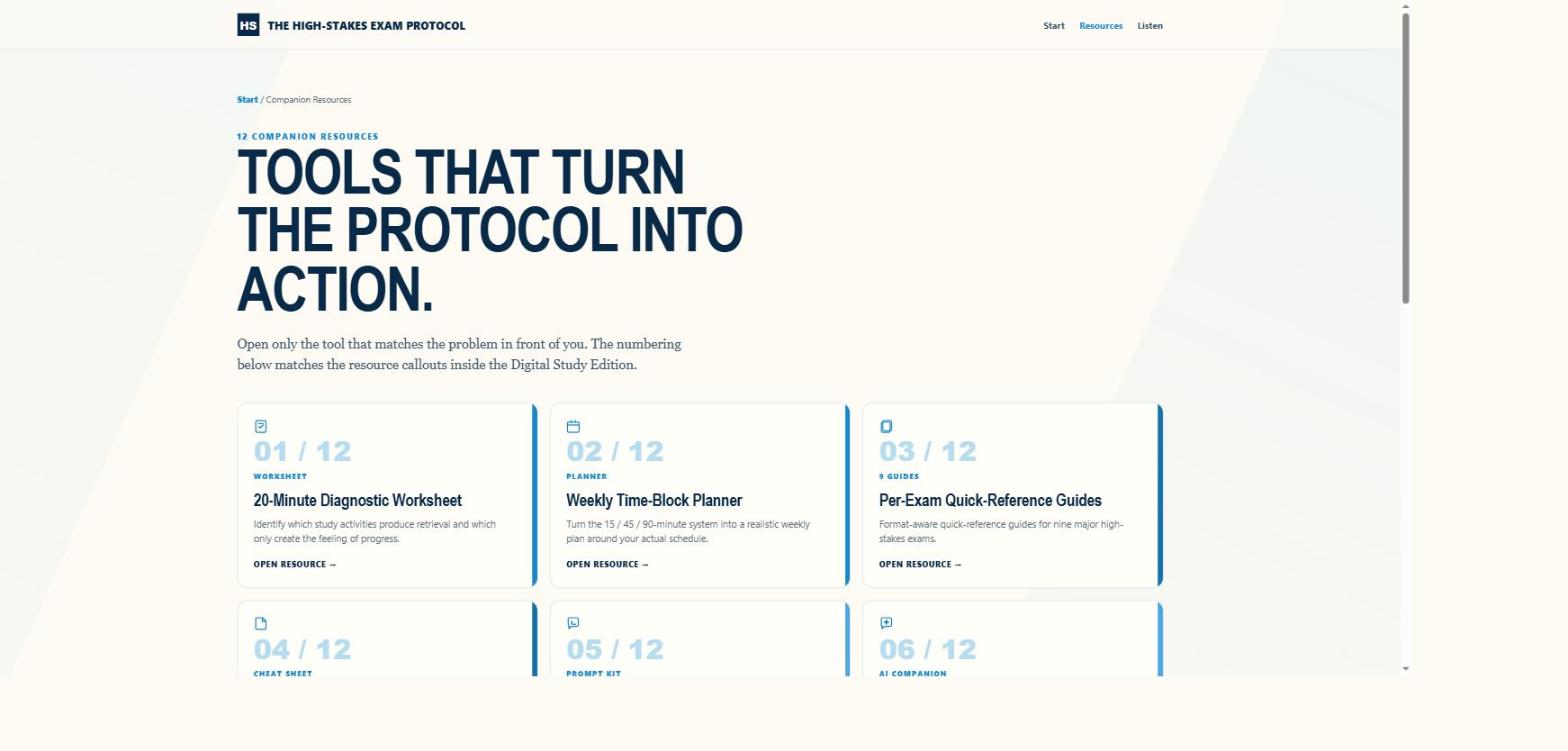
One. The Resource Hub, in full. You've seen it above — every page, every tool, every audio file. You see what you're paying for before you pay. Not a promise of what you'll get. What's there, on the day this page was written.
Two. The research the method is built on. Every study cited has a named author, a year, a sample size, and a journal:
- Dunlosky, J., Rawson, K. A., Marsh, E. J., Nathan, M. J., & Willingham, D. T. (2013). Improving Students' Learning With Effective Learning Techniques. Psychological Science in the Public Interest, 14(1), 4–58. 254 studies. Roughly 14,000 participants.
- Bjork, R. A. (1994). Memory and metamemory considerations in the training of human beings. The origin of “desirable difficulties.”
- Piotr Wozniak's SM-2 (1985) evolving into FSRS-6 (2024). The spaced-repetition algorithms inside Anki, now the default configuration for the AnKing deck and every serious clinical-exam flashcard workflow.
Three. My own story. I failed by three points. I know why. This book is the fix. My author bio further down tells you the two things this system will not do.
When you pass, and you will if you do the work the Protocol asks you to do, you'll get a form to leave a real review. With your name, your exam, your score. Those are the reviews I want stacking here. Not the ones I write myself.
The whole system, $29.
The book, the audiobook, the twelve companion tools, the AI Study Partner, the exam-specific playbooks, and the printable editions. One permanent link, yours forever.
Who this is for.
This is for you if you're preparing for one of these:
- CFA Level 2 or 3
- CPA (any of the six sections, post-2024 Evolution)
- USMLE Step 2 CK or Step 3
- Bar Exam, first attempt or retake, in any state
- MCAT, non-traditional or gap-year applicants
- PMP or CISSP
- AWS Solutions Architect (Associate or Professional)
This is not for you if:
- You're 18–22 living on campus with 40 hours a week to study. That's a great life. Cal Newport's How to Become a Straight-A Student is a better book for it.
- You want a book of practice questions. The Protocol is method, not content. Buy UWorld, Barbri, Kaplan Schweser, Becker, or your field's equivalent alongside this. Not instead of.
- You're looking for a motivational read. There's no cheerleading here. No athlete-mindset stories, no military metaphors, no Ivy-League lore. The book expects you to be an adult and treats you like one.
- You believe study science is bunk. It isn't. The studies are cited by name above.
And you recognize yourself in this pattern, common enough that I've seen versions of it posted on every major exam forum this month:
I'm grinding CFA L2 while doing 60h/week in audit. How the hell do you all study with a full-time job?
If you're preparing for a high-stakes exam I didn't name, and you have twelve to fifteen hours a week and a life that doesn't pause for it, this still works. The method is exam-format agnostic. The exam-specific playbooks cover nine formats. The underlying protocol covers all of them.
How it's different.
| Make It Stick | A Mind for Numbers | Straight-A Student | Kaplan / Barbri / Schweser | The High-Stakes Exam Protocol | |
|---|---|---|---|---|---|
| Length | 336 pages | 336 pages | 240 pages | 800–1,500+ pages | ~180 pages |
| Working professional friendly | No | Neutral | Explicit reject | Neutral | Yes (12–15h/week model) |
| Exam-format aware (vignettes, situational, essays) | No | No | No | Partial, single-exam | Yes, nine formats |
| Retake support | No | No | No | No | Yes (dedicated framework) |
| AI-era tooling (custom GPT, FSRS-6) | No | No | No | No | Yes |
| Companion tools at a single link | No | No | No | Codes + separate portals | Yes. One URL, forever |
| Written after 2024 | No | No | No | Content updated, framework pre-2024 | Yes |
But what about…
“I've already read Make It Stick / Oakley / Newport. What does this add?”
Those books teach you what to do. This book assumes you already know. It teaches you how to do it on Monday morning, with 90 minutes and 12 weeks to go, for your specific exam format. The gap between the two is where most of us lose the year.
“I don't have time for another book. I should be studying.”
Read the one-page playbook in the front of the book. It gives you 20% of the value in 20 minutes. If you don't want to read the rest, you don't have to.
“Anki and FSRS are for medicine. My exam is CFA / PMP / CISSP.”
FSRS is algorithm-agnostic. The Hub has example deck setups for CFA formulas, PMP process groups, and CISSP domains. Not medicine. You.
“Tools and templates? I've seen this game. The codes never work.”
No codes. No login. No email verification. One permanent link. You've already seen it in the screenshot above.
“If this really worked, wouldn't everyone do it? Pass rates would be higher.”
The techniques that work (spacing, interleaving, testing yourself before you feel ready) feel worse than the techniques that don't. Bjork named this in 1994. Most of us quit them within the first week because rereading feels more productive. That's the game.
“I've already failed once. Isn't this going to make me feel worse?”
The Retake Decision Framework in the Hub is written for candidates on their second, third, or fourth attempt. It tells you what to change, and how to tell the difference between a strategy problem and a life problem.
“Won't the AI Study Partner make me lazy?”
The Study Partner is built to quiz you, not explain to you. Ask it a question and it asks you three back. If you wanted an answer machine, ChatGPT is already free. The Study Partner is the opposite of that.
The author — and the limits.
I'm Marcus Reyes. I sat for a high-stakes exam three years ago. I studied every night for three months. I failed by three points. The day I found out, I sat in the parking lot of my office and couldn't move.
That night I did what I should have done the first night. I opened the score report. I looked at the questions I'd missed. And I realized every single one was a question I'd reviewed. Not once. Many times. I recognized the material. I couldn't recall it.
The next twelve weeks I built the first version of what became this book. I passed on the retake. Not by studying more. By studying differently.
The book isn't a memoir. It isn't a manifesto. It's the system I wish I'd had the first time.
Here's what the Protocol will not do:
- It won't teach you content. If the vocabulary, the frameworks, the diagnoses, the accounting standards, the case rules are new to you, you need a content course first. Buy UWorld, Barbri, Kaplan Schweser, or your field's equivalent. This is method, not content.
- It won't skip the required minimum hours. Every exam has a floor. USMLE Step 1 needs 300+ hours. CFA needs 300+ per level. Bar Exam needs a full dedicated cycle. This book makes those hours more efficient. It doesn't make them optional.
- It isn't magic. If someone tells you their system got them to pass on four hours a week without a content foundation, they're selling you something. The Protocol works because it removes what doesn't work. Not because it invents shortcuts that don't exist.
If any of that is a dealbreaker, this isn't for you. And I'd rather tell you now than after you've paid.
Frequently asked questions.
How is the book delivered?
The Resource Hub link arrives in your inbox within two minutes of purchase. Bookmark it. That's the entire delivery system.
Can I read it on Kindle?
The Hub includes an EPUB you can send to your Kindle library, and a printable PDF if you prefer paper. A physical paperback is available separately through IngramSpark distribution.
How long is the book?
About 180 pages. Designed to be read in 4–5 sittings of 45 minutes each. The one-page playbook at the front gives you the operating system in twenty minutes.
Does the AI Study Partner require ChatGPT Plus?
The Study Partner is a custom GPT hosted on OpenAI. You need a ChatGPT account (free tier works, though interaction quality is better on Plus). If OpenAI changes its policy on custom GPTs, the AI Prompt Kit is included as a fallback.
What if my exam isn't in the exam-specific playbooks?
The nine playbooks cover USMLE, MCAT, PMP, CISSP, Bar Exam, CPA, CFA, GRE, and LSAT. The method is format-agnostic. If your exam is a vignette-based clinical exam, a situational reasoning exam, an essay exam, or a quantitative-reasoning exam, one of the nine playbooks maps onto your format. If you're unsure, email support before you buy.
What if it doesn't work for me?
Try the 20-Minute Diagnostic tonight. It's the first thing in the Hub. If after doing it you don't have a clearer picture of what's actually breaking your prep, send us the completed Worksheet within 14 days and I refund you in full. Not on your word — on the work you did. That's the deal. Full details in the Refund Policy linked below.
Will I get updates?
Every update to the Hub — new tools, new exam guides, refinements — shows up at the same link. Forever. There's no version number to chase and no upgrade to buy.
14-day, Diagnostic-locked refund.
Try the Diagnostic first. If it doesn't work, send it back.
Try the 20-Minute Diagnostic tonight. It's the first thing in the Hub. If after doing it you don't have a clearer picture of what's actually breaking your prep, send us the completed Worksheet within 14 days and I refund you in full.
Not on your word — on the work you did.
That's the deal. Full details in the Refund Policy.
The next step.
Click the button below. Enter your card. You'll be in the Hub in two minutes. Open the book, read the one-page playbook, do the twenty-minute diagnostic tonight.
If you've been reading this page down to this line, you already know the pattern you're stuck in. You've probably known for months. The only thing left is whether you keep running it for another twelve weeks, or whether you spend the next hour learning how to break out of it.
Marcus Reyes